My top 5 places to invest for 2010 – Part 2!

July 29th, 2010 Dan No comments

As you saw in last weeks blog, i delved into my top 5 places to invest in property for 2010.

The first 3 were Cape Verde, Barbados and Barcelona.

Below are the last 2, and perhaps the most interesting.

4. Mallorca:

Known to many, invested in by few….

Mallorca is one of the most visited islands in Europe, most of us have been there be it on a lads holiday or a family one!

What many people don’t know is that because of building restrictions prices have not been effected by the global downturn anywehere near as much as their close neighbour Spain.
We have a villa in Puerto Pollensa and in 15 years have not seen it lose money, also long term lets are easy to obtain in the winter, it yields around 11% per year AFTER mortgage payments!

Combine this with an average 3 weeks use per year and it looks like a great investment.
As the cost of far away holidays spiral and many long haul operators upping prices or going under altogether, holidays closer to home tick boxes for many people.

The fact that more and more people are buying second homes in Mallorca combined with laws on future building means that prices are sure to steadily increase in the near future and with a vibrant holiday market rentals will follow suit.

Conclusion:


Risk = Low

Returns = Medium

Yields = Medium

Minimum cost to invest = £30,000

5. The UK

Well you knew it was coming didn’t you!

Ok the returns may not be as much as the countries mentioned earlier BUT many of you will have the market knowledge to know a “good deal” when you see it.

In this market many property investors that do look to invest are loking at minimising their risk as much as possible, for the masses that means not moving out of their comfort zones.

I’ll always tell you that using a property investment company is the way to go, they charge very little, normally get paid by the developer and have market knowledge and contacts that can only be gained by years in the business.

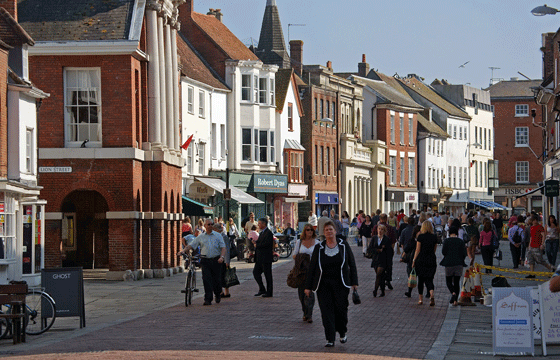
We have seen some really great stock recently, from tenanted apartments in Chorley yielding over 8% to townhouses in Chichester (where we are based) yielding close to 9% when let to students under an HMO license.

Check out our UK property investments for more information.

Conclusion:


Risk = Low

Returns = Medium

Yields = Medium

Minimum cost to invest = £20,000

To Finish……These are my 5 places to invest in 2010, i would hope that by 2011 i will have invested in at least 3 of them. If you have a location you are looking at and a reason why, post it below!

A good time to invest in property

July 26th, 2010 Barnaby No comments

I was just reading an article by BBC news about how taking investment advice from your bank is a bad idea. I’m sure many people reading this article will have been asked to speak to one of the financial advisors available at their local bank, who will tell them that investing their money in one of the banks medium/high risk funds is a good bet and it will return x%  and increase in capital by x%.

One of the ladies in the BBC news article had invested £100,000 into a “Cautious fund” and she quickly lost £40,000… unbelievable! Not only this, but the lady’s money was also decreasing at a faster rate because of the fact it was shrinking against the rate of inflation.

At a time of inflation coupled with low interest rates, ideally you would like to be in a position where you have an asset which is making you money and your borrowings on that asset are also, in real terms, shrinking while inflation is present. Your asset will be making you an increased amount of money with inflation and in comparison to your borrowings against it; the time at which you will have no outstanding finance will approach quickly. I am, of course talking about property.

It is no surprise that property investment has, for a long time, served as the main entry route to the forbes 100 rich list. The process of buying property in the right location at the right time and making sure the rent is going to cover the repayments you have on any borrowings, is just the start of it. The distance you can make your money stretch in property is insurmountable, by refinancing and keeping the cash flow on each property positive every month.

I have seen an article today from a top economic forecaster predicting that interest rates will remain at 0.5% until 2014; you may have also seen that the UK economy grew faster than expected last month inflation is at a rate of around 3% this typically means that the price of most goods and services are increasing at that rate and, ideally, your wage at work, as opposed to your borrowings on your property, which will be shrinking in comparison. Ideally I would be looking to invest in property now, take advantage of very little new build stock, the low interest rates available and use some of the positive cash flow generated every month to reduce my borrowings, so when interest rates do finally rise I am less susceptible to increased repayments.

See some of our UK investment opportunities here

More strong news for Cape Verde Property Investment

July 19th, 2010 Barnaby No comments

Cape Verde BeachThe International Monetary Fund (IMF) have conducted their eighth and final review of the Cape Verde Islands and yet again it is fantastic news for anyone invested or interested in investing in Cape Verde Property.

The IMF have stated that they believe Cape Verde’s growth will continue through 2010 with inflation remaining low. This is good news for the islands that are already showing very strong growth indicators and are becoming a real investment hotspot.

The IMF have shown that they believe that “Real GDP” will be increasing at a rate of around 6-7% pa over the next 5 years (“Real GDP” is the size of an economy with allowances for inflation) meaning that the value of all goods and services produced or passing through the country will be increasing by 6-7% and therefore the size of the economy will be growing and people, on average, will be able to benefit from a better standard of living and companies can begin to grow, allowing more money to go back into the development of infrastructure.

Lots of the growth for these islands comes from increased Tourism and an increased level of investment in property and then infrastructure. Property prices on the island have been rising on average by around 15% per year.  The islands have remained a relatively undiscovered gem in comparison to the Caribbean and its northern counterpart, the Canary Islands, where property prices can be as much as 40% higher. They are only a 5 hour flight from the UK, have a time difference of only GMT – 2hours and benefit from 360 days of sunshine per year. Tourism figures have been increasing year on year and the island of Sal has seen increases of around 27.5% per year, as the only island with a truly international airport.

All of this information leads to a great location for investment in property serving the tourist industry. The investment we are presenting at Fresh Invest takes full advantage of the increasing tourism figures and can realistically provide investors with a net rental income of £12,133 per year for an investment as low as £32,294. All of this in a beachfront, 5* resort that gives purchasers 5 weeks free use per year.

To find out more about our investment in Cape Verde click here.

For the report by the IMF click here.

My top 5 places to invest for 2010

July 12th, 2010 Dan No comments

The property market in many countries has taken a real hit over the last few years, however this sometimes is not a bad thing.

If your looking at property investment as an alternative to stocks and shares then the time may be ripe to invest.

Below are my top 5 places to invest.

1. Cape Verde:


When looking for an overseas investment opportunity the first thing you should always ask yourself is “would i go there”. If the answer is no, the chances are your not in the minority.

The next question is, if you would go there, why?

For me Cape Verde offers a unique proposition, 360 days worth of sun that you can access via a 5 hour flight.
Combine these 2 points and it narrows the field down considerably; quite honestly the competitors i’ve either been to or i’d never want to.

The reason for this is as follows, not only does Cape Verde have a Caribbean climate but also a laid back lifestyle unlike many of its competitors.

The Prices are still relatively low compared to the likes of Tenerife and some Caribbean islands, this is mainly due to the infancy of the islands that make up Cape Verde.

This will not be the case for long, already some major 5 star hotel operators are building on the islands of Sal and Boavista, this will increase tourism and put more pressure on Airline operators to increase their flights.

One such 5* hotel operator is Sol Melia – the worlds largest hotel resort operator, they are taking over the running of our Dunas Beach Resort investment opportunity.

Conclusion:


Risk = Medium

Returns = High

Yields = High

Minimum cost to invest = £33,640.

2. Barbados:


If you have deeper pockets abd want slightly less risk then Barbados may be for you, offering the true 5* lifestyle with prices to boot.

The reason i think this is a good investment is that even though prices are high, you can still achieve yields in excess of 10%, as witnessed in our opportunity on the West Coast Barbados.

Yields this good along with the knowledge that you are investing in the holiday makers favourite Caribbean island means that occupancy rates should remain strong. Most other Caribbean islands are so far behind that no threat to this crown seems anywhere near appearing.

Demand is Barbados is so high it has become the place for celebrities to have second homes, as proved by a host of premier league footballers, golfers and tv personalities.

Conclusion:


Risk = Low

Returns = Medium

Yields = High

Minimum cost to invest = £64,990.

3. Spain – Barcelona:


I love Barcelona, its my favourite city by a long ways.

Sea, Sun, Football, Great Beaches, Great Nightlife andf now a grand prix! I don’t know another city that offers so much.

I also think its a bit of a hidden gem, 1 bed apartments on the outskirts of Barcelona can be picked up for around €160,000 and if you can rent them for 40 weeks of the year you should be on for close to a 8% yield. Not bad for one of the most cosmopolitan cities in the world.

Demand will always be strong because of the sheer size and climate of Barca.

Combine this with the fact that house prices in Barcelona have hardly been effected by the global financial crisis and you know that values will remain robust in all but the most dire of circumstances.

Conclusion:


Risk = Low

Returns = Medium

Yields = Medium

Minimum cost to invest = £27,111

Too see what numbers 4 and 5 are, check back next week!

The new era of overseas property investment

June 17th, 2010 Barnaby No comments

In the past investing in property overseas was an arduous process, finding a suitable property was not the problem, it has always been the due diligence involved in an overseas purchase. Are you buying in the right location for Capital Growth? Will you be able to let your apartment or villa for long enough to cover your repayments on any finance used? What is happening to the local property market at present? Is there a long and complicated buying process? Will your apartment or villa be up to the standard promised by the developer? The questions can continue forever.

Investors are of course and rightly so, more tentative about investing overseas because of the reputation that some overseas developers have given the market when they, ran out of money or built a development that was subpar and then scarpered before the investor could so much as ask for their money back. But the thing that attracted investors to the overseas market in the first place is that chance of finding the property in a location that will provide you with capital growth and a large positive cash flow to line your pockets every month, with the added benefit of a free holiday.

Now we carry out a full due diligence test on all of our developments and our due diligence test on overseas property is second to none. However without any request from ourselves or our investors, we have just received one of the best partners for our due diligence tests that money could buy. The hotel operator!

When you purchase an investment property in an overseas development that is due to be run by a hotel operator, as soon as the agreement is made the developer is not now building to the standard of the investor, they are now building to the very high standard of a hotel operator and if they don’t, they risk losing the operator. Not only will the standard of your property be of the upmost quality but you now have somebody with a large web presence to promote your apartment for you, meaning that your apartment or villa is tenanted as often as possible and you are therefore provided with a handsome return. The hotel operators will of course also carry out very strict due diligence on the location to make sure that it is in a location where occupancy can be maximised and therefore your return can be maximised which will, in turn, add value to your investment.

We have 2 overseas developments that fit this bill exactly at present:

Dunas Beach Resort

The developer of Dunas Beach Resort has recruited “Sol Melia” to run the resort upon completion. Sol Melia are the largest resort operator in the world and are constantly winning awards for their dominance in the market and the quality of their resorts. The build cost of this resort in relation to any others on island is double and they have already completed one resort on the island and the results speak for themselves.

West Coast Property, Barbados

The developer of our properties on the West Coast of Barbados has recruited Mango Bay Resorts to carry out the hotel operations on site. Mango Bay constantly receive fantastic reviews for their operations on Barbados and their average occupancy is 80% which, in our resort, would give investors a return of up to 23% per year! The developer also offers purchasers the chance to help with the design of their apartment on line throughout the construction period.

Ladies and Gentlemen this is the future of overseas property investment!

Capital Gains Tax Increase – Fresh views

May 20th, 2010 Barnaby No comments

With news that the new Con/Lib coalition are to raise the tax due on Capital Gains for anyone selling a second property Fresh Invest shares it’s views on how this may affect the property investment market.

Firstly let’s decide why the government has decided to impose this new tax there are 2 main reasons:

  1. The previous government has run up an astronomical budget deficit – hence the note recently left by the outgoing treasury minister Liam Byrne, to the new chief secretary David Laws which stated “Dear chief secretary, I’m afraid there is no money. Kind regards ­ and good luck! Liam.” For this reason it is imperative that the new government make a lot of cuts, to bring the level of this deficit to an acceptable level they need to recoup money from the tax payers and this new capital gains tax will do just that.
  2. The second reason is that because of the slack lending criteria over the past decade many people have bought up a large amount of property in small holiday towns throughout the south of England, through this they artificially increased the prices of all the houses around these areas and they are now financially out of reach of the average worker in those towns.

The government is therefore going to impose an increased Capital Gains Tax on all second home sales as a way of raising cash for themselves and a way of stopping people becoming too greedy and putting house prices out of reach for first time buyers in holiday locations throughout the UK.

Now what could happen as a result of an increase in Capital Gains Tax?

The big sell off – This first scenario would really depend on when the government decides to impose this new tax, if they decided to impose the tax from the new tax year i.e. 6th of April 2011 then I would suspect a big sell off of second homes in desirable locations, creating a very large influx of supply into the property market and without the demand to match, probable falls in prices.

The buy and hold – The other scenario, I believe would also depend on the time the new tax is imposed. I would suspect that if it was to be imposed straight away then second home owners and investors alike may decide not to sell their properties as the gains are no longer high enough. Hopefully this will not cause any form of stagnation in the already fragile property market.

One thing is for sure. This will slow down the purchasing of property just for the capital gains that come with it, as the risks may begin to outweigh the possible rewards .An advantage of this however will mean that investors do not inflate property prices further and therefore eliminate first-time buyers from the market. Hopefully this will lead to longer, sustained growth.

Maybe it’s time to look to the overseas property market for your significant capital growth?

What are your views?

Fresh Invest is a property investment company with the aim of maximising our investor’s funds whilst minimising their risk. For more information see www.freshinvest.co.uk or phone 0800 043 69 56.

Spring market bounce defies political fears

May 12th, 2010 Barnaby 1 comment

The traditional slowdown in the property market coming up to the election, was not enough to eradicate the increase in housing sales, enquiries and prices that come with the spring season every year.

As the election comes around people traditionally slow their searches for new properties, in a hope to not overexposing themselves to possible new policies, which could leave them struggling once the new government has been decided. One such new policy could be an agreement to hold the interest rates at a current low level, this will of course be beneficial to anyone looking to trade up in the housing market and possibly leverage themselves further against the value of their property, if interest rates were due to increase this could be a problem for would be house buyers as they may struggle to match the repayments.

On the other hand it is normal in Britain for the property market to have somewhat of an upsurge in interest during spring, this can be attributed, partly to the sun making house hunting a more pleasant experience and also, to the budget which is often announced late in March and provides more certainty to market conditions.

It is good to see this news, as now the new government has been decided and are getting to work, we would expect the current trend in new house buyers and a slow increase in house prices to continue, as people are given more certainty in the position they will be in, come the next few months. There are a few interesting policies being taken into government, it will be interesting to see what the Lib-Dems have in store with the new “safe start” mortgage, designed to stop new buyers slipping into negative equity.

News of the increase in prices and sales came from RICS this month, as they published their latest monthly survey of some 245 members of the RICS who work as estate agents.

Fresh Invest is a property investment company with the aim of maximising our investor’s funds whilst minimising their risk. For more information see www.freshinvest.co.uk or phone 0800 043 69 56.

What will the election mean to the property market?

May 6th, 2010 Dan No comments

3 political partiesThis election could mean boom or bust to the already fragile property market in the UK.

As we all know, possibly the largest challenge facing the new government will be our economy. The 3 big parties have outlined the steps they will take to try to deal with the £170bn deficit in the UK’s finances.

With it looking increasingly like a hung parliament, what will be the main points of debate from these parties on our property market?

Listed below are some of the key points of each party.

Conservative:

  • Scrap home information packs
  • Keep the £250,000 stamp duty threshold for the foreseeable future
  • Add a new 5% stamp duty threshold for £1m properties from April 2011
  • Increase inheritance tax threshold to £1m
  • Regards Northern Rock, they have not stated whether they will consider remutualisation
  • Include more local initiatives rather than large scale regional building plans
  • Will look to split state and part owned banks into 2 parts, retail and investment

Labour:

  • Add a new 5% stamp duty threshold for £1m properties from April 2011
  • Keep the homebuyer direct scheme for low earners
  • Keep Home Information Packs
  • The £250,000 stamp duty threshold is due to expire in March 2012
  • 10,000 affordable homes to be built a year by 2014
  • Northern Rock: Manifesto pledge to consider remutualisation as an option, ‘while ensuring the sale generates maximum value for the taxpayer.’
  • Will look to break up large banks but probably not into retail and investment
  • Maintain the standard interest rate on the Support for Mortgage Interest Scheme at 6.08 per cent until December 2010.

Liberal Democrats:

  • Charge VAT on new homes
  • 1% “supertax” on homeowners with properties worth over £2m.
  • Create a new “Safe Start” mortgage that keeps buyers from slipping into negative equity
  • Propose a green loan for people to invest in home energy efficiency and micro-renewables
  • Get rid of home information packs and keep energy performance certificates
  • Consider remutualisation regards Northern Rock
  • Will split state and part owned banks into retail and investment
  • Concentrate on local rather than large regional building plans.

Fresh Invest is a property investment company with the aim of maximising our investor’s funds whilst minimising their risk. For more information see www.freshinvest.co.uk or phone 0800 043 69 56.

SIPP’s, The leaders debate and the £59 pension

April 23rd, 2010 Barnaby No comments

After watching the leader’s debate last night, one thing stuck in my mind, it wasn’t any particular party policy (at the moment it seems they all have flaws somewhere) it was… the poor old lady that is currently having to live on £59 per week as her state pension!

The thing that I find the worst about this is that, we all know that by putting our pension in the hands of the government, we are never truly in control. I, like many others, like to be in control of my finances and this is where I would like to make the case for the Self Invested Personal Pension (SIPP) known.

Not only do I like to know how much of a pension I will have to live on come retirement age, but I would also like to be able to increase this amount which will either mean me retiring earlier than originally planned or living a more prosperous retirement period. The only way you can truly take control is by utilising the money in the form of a SIPP. There are fantastic benefits available for people putting money into a SIPP such as attracting tax relief at your tax rate; this means that if someone is taxed at 40% the government will add 40% to any contributions they make towards their SIPP!

Another advantage to a SIPP is the ability to borrow up to the value of 50% of your SIPP to increase your buying power this means; if an investor has a pension value of £100,000 they can then borrow a further £50,000 against this, giving a purchasing power of £150,000.

I believe that the only real way to have a secure and happy retirement is to use a SIPP to invest in property, be it in the UK or Overseas. The returns available in our Cape Verde Investment for example, show that if an investor had a pension value of around £84,000 they could increase this figure to around the £300,000 mark in 10 years, and still have an apartment providing a net profit per year of £12,000! This is based on pessimistic figures, assuming that growth isn’t as good as it has proven to be over the past few years.

We think now is a fantastic time to invest in any property with your SIPP, especially those in Cape Verde; which is a real emerging country currently receiving 15% growth per annum and tourism increases of around 27.5% pa expected to top 1,000,000 per year by 2015.

For more information on investing in property with the use of your pension including unlocking frozen pensions contact info@freshinvest.co.uk

UK home owners take advantage of low interest rates

April 12th, 2010 Barnaby No comments

BBC news reported last week that homeowners have been paying off record amounts of their mortgages over the course of the past year. In total UK homeowners paid off £22.3bn last year! We believe this is great news for the housing market and therefore the property investment market.

The reason for this is simple:

When the banks dropped their interest rates, UK home owners on a tracker or variable rate mortgage had 2 choices:


-          Spend their increased discretionary income as they wish living a better lifestyle with luxury goods or,
-          Invest their increased discretionary income back into their property.

Now this piece of news shows that the majority of UK homeowners have chosen to do the latter…

Well done UK! The reason this is so good for us as a nation is that we, and therefore the banks, are now not so heavily leveraged on our properties and when the Bank of England inevitably raises the interest rates, we will still be able to afford the repayments on our now smaller borrowings.

This piece of reassuring news can put your mind at rest that the UK house prices should remain buoyant and we will not see the “dead cat bounce”

Others will argue that the idea of lowering interest rates is to get the UK homeowners to spend their increased discretionary income in the consumer markets, However, I don’t agree.

As interest rates dropped UK homeowners continued to keep the consumer markets ticking over as they paid off their mortgages. It would seem we have got through the hard stage and now we are in a good position to continue spending in the consumer markets, whilst maintaining our now lower mortgage repayments… Either way we see this as good news!